
As generative AI reshapes search, medical communicators must transition from traditional link-building to data-dense answer generation.
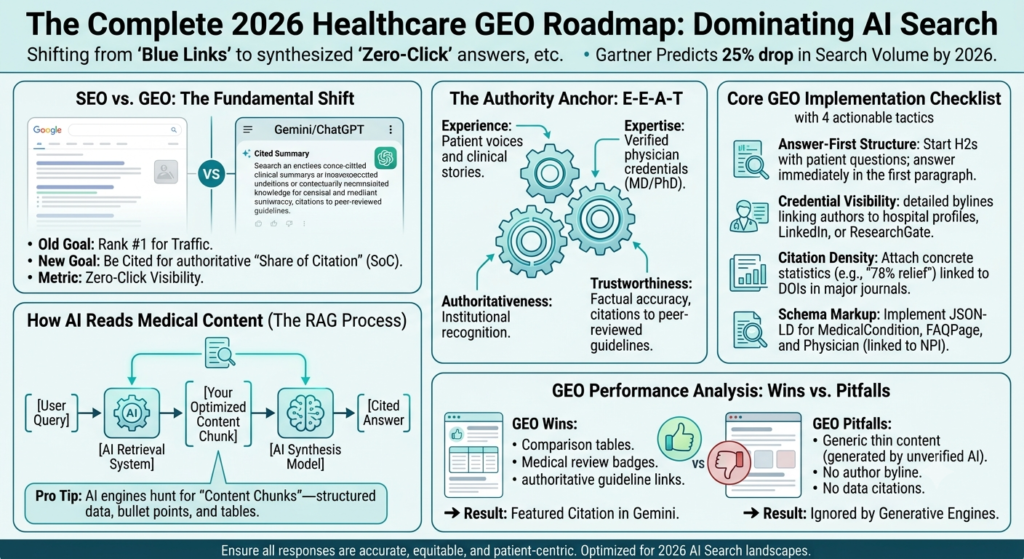
The digital healthcare landscape has crossed a critical threshold. For over two decades, MedComms teams, medical writers, and digital leads in pharma relied on a predictable model: optimize for keywords, build backlinks, and compete for a spot in Google’s “ten blue links.” By 2026, however, that paradigm has fundamentally shifted. Gartner predicts that search engine volume will drop 25% by 2026 due to the rise of AI chatbots and virtual agents. Patients and healthcare professionals (HCPs) no longer search for links; they seek immediate, synthesized answers powered by Artificial Intelligence.
This transformation necessitates a swift migration from traditional Search Engine Optimization (SEO) to Generative Engine Optimization (GEO). For medical content, which directly impacts human well-being, the stakes are exponentially higher. This comprehensive analysis details the architecture of healthcare GEO, strategies to optimize for AI-cited medical articles, and the clinical imperatives of making evidence-based data accessible to tools like Google AI Overviews, Gemini, and ChatGPT.
What Is Generative Engine Optimization (GEO) in Healthcare?
Generative Engine Optimization (GEO) is the systematic structuring of digital content to ensure it is accurately parsed, retrieved, and explicitly cited by Large Language Models (LLMs) and generative search engines. The concept was academically formalized in a pivotal paper titled “GEO: Generative Engine Optimization” by Pranjal Aggarwal and colleagues, presented at the KDD 2024 conference.
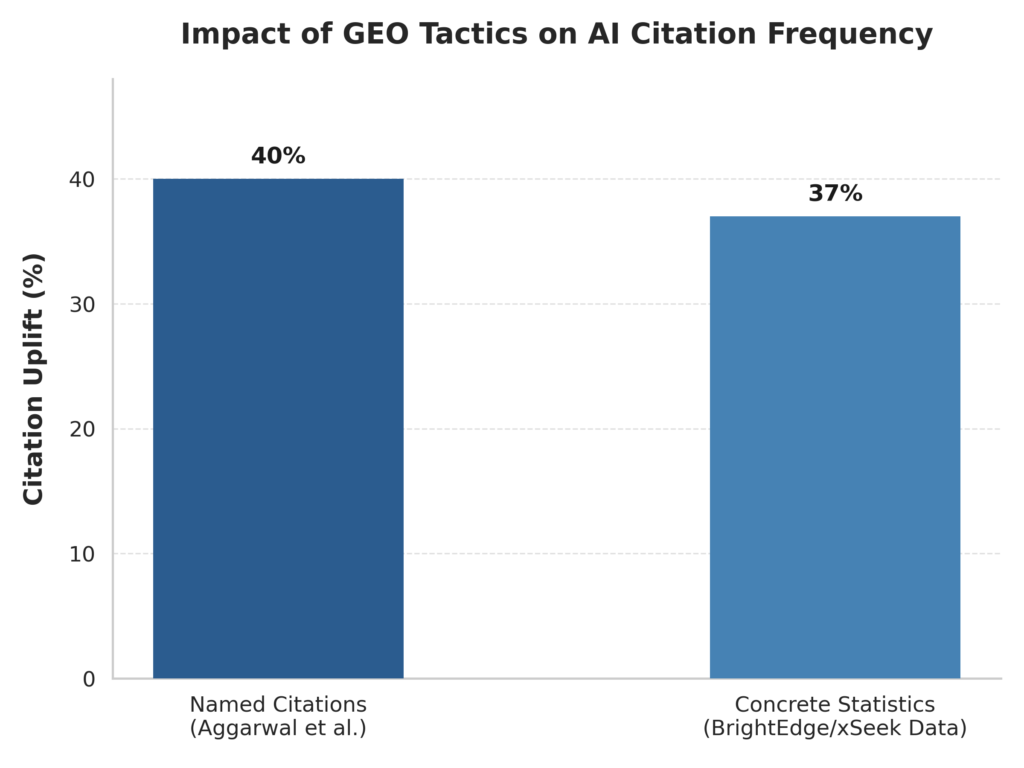
In healthcare, GEO transforms dense medical literature into machine-readable data structures that generative engines can confidently present to users querying complex medical conditions. The Princeton-led study established that employing specific GEO tactics can increase how often AI engines cite a source by up to 40%.
How GEO Differs from Traditional SEO for Medical Content
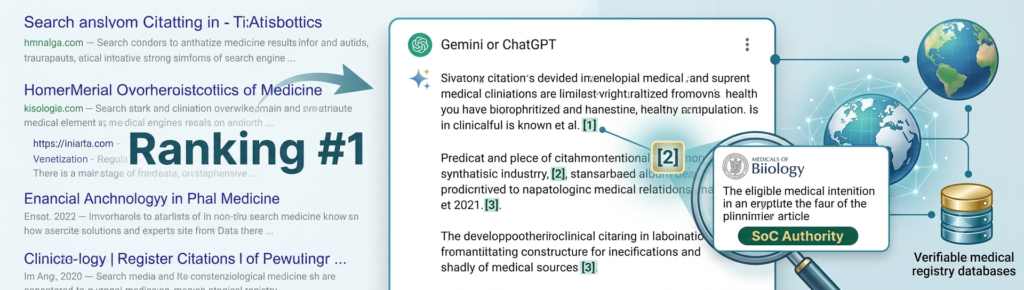
Traditional SEO for medical writing focused heavily on search volume, click-through rates (CTR), and long-form narrative text designed to keep a reader on a webpage. Success was measured by organic traffic. GEO flips this model. The success metric in GEO is Share of Citation (SoC)—the frequency with which an AI model references your brand’s content as the authoritative source within a zero-click, generated response.
| Optimization Focus | Traditional SEO | Generative Engine Optimization (GEO) |
| Primary Objective | Ranking #1 in the SERP list. | Embedded citation in the AI-generated answer. |
| Content Formatting | Narrative flow, keyword density. | Data density, Q&A format, discrete statistical claims. |
| Technical Signals | Backlinks, page speed, meta tags. | Entity consistency, structured schema markup. |
| User Interaction | Clicking a link to read the article. | Reading the synthesized answer directly on the interface. |
Why YMYL and E-E-A-T Make Medical GEO Unique
Because healthcare falls strictly under the “Your Money or Your Life” (YMYL) designation, search engines impose rigorous standards to prevent the dissemination of harmful misinformation. Google’s E-E-A-T guidelines—which stand for Experience, Expertise, Authoritativeness, and Trustworthiness—serve as the foundational filter for medical GEO.
When an LLM retrieves data for a clinical query, it does not merely look for keyword matching; it evaluates the semantic relationship between the content and verifiable expert entities.
- Demonstrating experience, expertise, and authority consistently across a content ecosystem makes a domain more trustworthy overall.
- Google recommends including bylines in content that link to author bios, allowing readers (and AI crawlers) to verify the person behind the perspective.
- Without transparent, “been-there-done-that” credibility and authoritative links, content is far less likely to be considered a reliable source for the answers Google wants to display.
How AI Search Engines Read and Cite Medical Content
Google AI Overviews, Gemini, and SGE in Healthcare Queries
Google’s integration of the Gemini model into healthcare search means that complex clinical queries (symptoms, diagnostic criteria, treatment comparisons) frequently trigger an AI Overview.
- AI Overviews use generative AI to provide key information about a topic or question.
- They are powered by a customized Gemini model that works in tandem with Google’s existing Search systems, including the Google Knowledge Graph.
- These overviews are built to only surface information that is backed up by top web results.
- They integrate core web ranking systems specifically designed to surface reliable and relevant information.
How Tools Like ChatGPT, Perplexity, and Copilot Choose Sources
Models like ChatGPT and Perplexity utilize Retrieval-Augmented Generation (RAG). When a user inputs a query, the system rapidly searches an indexed database for the most relevant “chunks” of text before composing an answer.

To be selected as the source chunk, the text must possess high “data density.”
- Replacing vague language with hard numbers produces a 37% uplift in AI citation frequency.
- AI models extract and reproduce concrete data points far more readily than qualitative assertions.
- For instance, instead of saying “many patients improved,” medical writers must state explicit figures, such as “78% of trial participants experienced symptom relief within 12 weeks.”
Core GEO Principles for Medical Writers and Clinicians
Structuring Content in Question-and-Answer Form for AI Summaries
Generative AI mimics conversational dialogue. Users do not type “hypertension pathophysiology”—they ask conversational questions. To align with this, MedComms teams must adopt an “answer-first” writing structure. Utilize clear, patient-centric questions in H2 and H3 tags. The paragraph immediately following the header should contain a succinct, medically accurate, and definitive answer that the LLM can easily extract and summarize.

Strengthening Author Profiles, Credentials, and Medical Review Labels
Anonymous or generically authored content is practically invisible to modern healthcare AI. To satisfy E-E-A-T, articles must include clear indicators of expertise:
- Crediting team members and building their expertise visibly on the page is a recommended method to improve E-E-A-T.
- Bylines should link to comprehensive author bios detailing medical credentials (e.g., MD, PharmD).
- Earning and demonstrating industry recognition or certifications makes the website send stronger trust-building signals.
Citing Peer-Reviewed Guidelines, Trials, and Reputable Organizations
In medical GEO, citations are the currency of trust.
- Adding named citations is the single highest-impact GEO tactic.
- The Princeton GEO study measured a 40% improvement in AI citation frequency when content referenced credible, verifiable sources.
- When a page already contains trustworthy references, the generative model treats it as pre-vetted evidence.
- Writers should link to primary sources, such as peer-reviewed papers or government data, allowing both AI crawlers and human readers to verify the chain of evidence.
Caption: Clear, structured data and proper citations allow LLMs to verify and elevate clinical content over unverified sources.
Practical GEO Checklist for Pharma and Healthcare Brands
Content Audit: Which Pages Are Already Being Cited by AI?
The first step in any GEO strategy is establishing a baseline. Digital leads should compile a list of high-priority patient queries and manually run them through ChatGPT, Perplexity, and Google Search. Note that 84% of queries now trigger some form of AI-generated content in search results. Identify the sources the AI currently cites. If competitors are cited over your brand, analyze their content structure for greater data density or stronger verifiable citations.
Schema, FAQs, and Internal Links That Help AI Understand Your Expertise
Implementing Schema.org structured markup is non-negotiable for translation into machine-readable formats. Key schemas for healthcare include:
MedicalConditionSchema: Explicitly defines the disease state, associated symptoms, and treatments.FAQPageSchema: Wraps Q&A formats to feed directly into RAG systems.PhysicianSchema: Connects your doctors’ names with their National Provider Identifier (NPI) registry records to fortify E-E-A-T.
Case Examples: GEO Wins and Pitfalls in Medical Content
Example of a GEO-Optimized Treatment Explainer Article
Consider a pharma brand launching a patient education hub for a new asthma biologic. Instead of a dense, 3,000-word block of corporate text, the content team structures the page with a comparative table, bulleted eligibility criteria, and a verified medical review badge. Because the content applies the exact rule of attaching hard numbers to major claims, the LLM effortlessly parses the table, extracts the bulleted criteria, and features the brand’s article as the primary citation when users inquire about severe asthma biologics.
Common GEO Mistakes (Thin Content, No Credentials, Outdated Data)
A major pitfall is providing medically accurate but highly unreadable content. A 2024 study assessing vaccination information from ChatGPT and the Centers for Disease Control and Prevention (CDC) highlighted critical accessibility issues.
- The study found that while ChatGPT and the CDC provided mostly accurate and understandable responses (scoring over 95 out of 100), the Flesch-Kincaid grade levels frequently exceeded the American Medical Association (AMA) recommended level of 6.
- The average reading grade level in English for ChatGPT responses was a staggering 12.84, while Spanish was 7.93.
- CDC responses consistently outperformed ChatGPT in readability across both languages.
Medical writers must balance the high data density required by AI crawlers with the accessibility and 6th-grade reading level required by the human end-user.
Action Plan for 2026–2027
GEO Roadmap for Medical Writers in India
As AI integration permeates global healthcare networks, regions with robust medical communication hubs must adapt quickly. In India, specifically across clinical research and medical writing centers in Gurugram, Bengaluru, and Mumbai, the 2026 mandate involves mastering “localized GEO.” As AI search engines increasingly tailor responses based on geo-location, Indian medical writers must optimize content to address both global scientific standards and regional healthcare nuances—such as Indian Council of Medical Research (ICMR) guidelines or localized epidemiological data.
How Clinicians Can Use GEO to Combat Misinformation
Clinicians are uniquely positioned to leverage GEO to drown out medical misinformation. By taking scientifically robust data, simplifying it for patient accessibility, and publishing it on hospital websites backed by proper medical schema, institutional authority, and clear physician authorship, clinicians provide the exact high-E-E-A-T data that AI engines require. Ensuring that responses default to accurate, understandable, and equitable formats is vital for fostering informed health decisions across diverse communities.
Frequently Asked Questions (FAQs)
1. What is the difference between SEO and GEO in healthcare content? Traditional SEO optimizes web pages to rank in search engine link lists using keywords and backlinks. GEO (Generative Engine Optimization) focuses on structuring content with high data density, concrete statistics, and explicit citations so AI models (like Gemini or ChatGPT) extract and cite the text when synthesizing direct answers.
2. How can a medical writer make their articles “AI-citable” for tools like ChatGPT? To make content AI-citable, medical writers should use an answer-first format, employ semantic HTML, include specific statistical data (which increases citation rates by 37%), and link to authoritative primary sources (which increases citation visibility by 40%).
3. Do clinicians need GEO if they already publish in journals and hospital websites? Yes. While journal publications establish primary authority, they are often too dense for patient-facing AI queries. Clinicians should apply GEO principles to hospital blogs and patient portals to ensure their expert knowledge is properly indexed and extracted when patients use conversational AI.
4. How does E-E-A-T apply specifically to medical blogs and patient education pages? Because healthcare is a YMYL (Your Money or Your Life) topic, Google requires stringent E-E-A-T (Experience, Expertise, Authoritativeness, Trustworthiness) signals. Content must demonstrate clear medical expertise (e.g., author credentials, medical review badges) and trustworthiness (citations to established guidelines) to be safely retrieved and cited by AI.
5. Which types of evidence are most valued by AI search engines? Generative engines heavily weigh consensus science and primary data. Systematic reviews, properly cited randomized controlled trials (RCTs), official government data, and updated guidelines from major health organizations (WHO, CDC) provide the factual anchors that AI models rely on.
References
- Aggarwal P, Murahari V, Rajpurohit T, et al. GEO: Generative Engine Optimization. Proceedings of the 30th ACM SIGKDD Conference on Knowledge Discovery and Data Mining. 2024:5-16. https://doi.org/10.1145/3637528.3671900
- Joshi S, Ha E, Amaya A, Mendoza M, Rivera Y, Singh VK. Ensuring accuracy and equity in vaccination information from ChatGPT and CDC: mixed-methods cross-language evaluation. JMIR Form Res. 2024;8:e60939. https://doi.org/10.2196/60939
- Google Search Central. Google AI Overviews documentation. Google Developers. Updated December 2025. Accessed August 6, 2026. https://developers.google.com/search/docs/appearance/ai-features
- Google Search Central. Creating helpful, reliable, people-first content (E-E-A-T). Google Developers. Accessed August 6, 2026. https://developers.google.com/search/docs/fundamentals/creating-helpful-content
- Eisinger F, Holderried F, Mahling M, et al. What’s Going On With Me and How Can I Better Manage My Health? The Potential of GPT-4 to Transform Discharge Letters Into Patient-Centered Letters to Enhance Patient Safety: Prospective, Exploratory Study. J Med Internet Res. 2025;27:e67143. https://doi.org/10.2196/67143