Author

Plagiarism detection in medical science is at a pivotal juncture. As artificial intelligence (AI) becomes deeply embedded in the editorial workflows of biomedical journals, concerns over academic integrity and research ethics have never been more pressing. The dilemma is clear: AI writing assistants and powerful paraphrasing tools are accelerating manuscript preparation, but they’re also fueling new forms of scientific misconduct. This whitepaper explores how AI-powered plagiarism detection is reshaping scientific publishing, and what editors, authors, and publishers must do to maintain the highest standards of originality and trust in medical research.
The Escalating Challenge: From Simple Copying to AI-Generated Text
Historically, plagiarism in science was synonymous with blatant “copy-paste” infractions—relatively easy to detect and address. Today, the landscape is more complex. The rise of AI in medical publishing has introduced a new dimension: so-called “Aigiarism”—plagiarism facilitated by advanced AI tools that produce content nearly indistinguishable from original writing.
Key concerns:
- Paraphrasing at Scale: AI-driven rewriting tools can rephrase large volumes of scientific text while closely mirroring structure and ideas.
- Semantic Imitation: Neural networks and large language models generate novel sentences but often rely on known literature, blurring the lines between inspiration and imitation.
- Content Creation: AI can synthesize entire sections or papers, posing a major challenge to traditional plagiarism checkers.
| Type | Description | Relevance in AI Era |
|---|---|---|
| Verbatim Plagiarism | Direct copy-paste from original works | Easily detected by most tools |
| Mosaic / Paraphrase | Close paraphrasing without substantial originality | Increasingly common; harder to spot |
| Self-plagiarism | Reusing own prior published content | Rises with text recycling methods |
| AI-Generated (“Aigiarism”) | AI-created text that replicates structure/meaning | Sophisticated & challenging to detect |
The Double-Edged Sword: AI as Both Tool and Threat
AI’s dual role is central to the evolving challenge. While AI-powered editorial workflow tools facilitate plagiarism prevention, they also offer potent capabilities for generating content that evades detection.
Benefits of AI-Based Plagiarism Detection:
- Enhanced Sensitivity: Advanced plagiarism checkers use neural networks and semantic analysis—going beyond simple word matching to examine context and meaning in submissions.
- Broad Coverage: Cross-checking massive databases, including open-access publications and web content, speeds up and strengthens the editorial process.
- Detection of Subtle Paraphrasing: Next-gen plagiarism detectors find writing that mimics source material even with rephrased sentences or changed structures.
Risks and Limitations:
- AI-Generated Plagiarism: AI writing tools can create “original” text that closely emulates published research, eluding conventional safeguards.
- Image Manipulation: AI can also fabricate or alter scientific figures, challenging reproducibility and visual data integrity.
Practical Impacts Across the Editorial Workflow
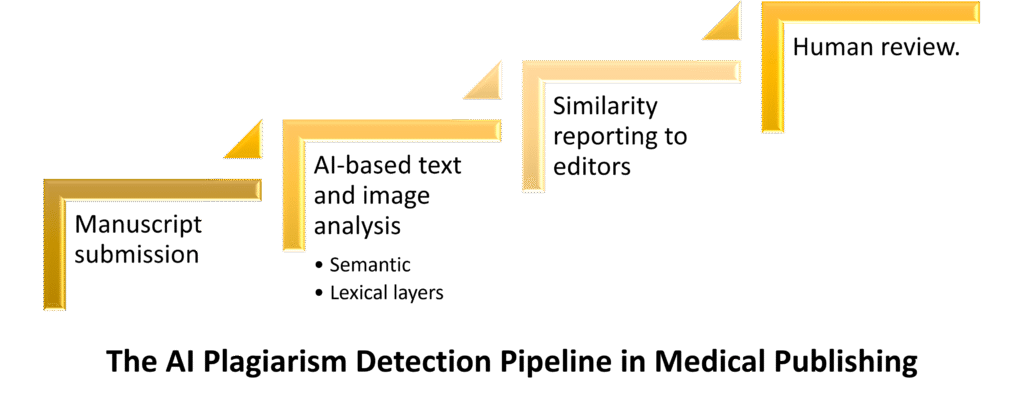
As artificial intelligence transforms plagiarism detection in medical science, several practical implications emerge for key stakeholders:
- Editorial Teams and Reviewers: Most leading biomedical journals mandate AI-based plagiarism checks for new submissions (e.g., Turnitin, iThenticate, Copyleaks), especially to flag subtle paraphrasing and identical passages.
- Authors: Use of AI writing assistants is now commonly declared; transparency around AI tool usage is increasingly enforced as part of journal guidelines.
- Publishers: Policy harmonization is a must—global publishers seek standardized approaches to detecting and dealing with all forms of plagiarism, including AI-generated content and image/data manipulation.
| Tool Name | Methodology | Strengths | Weaknesses |
| Turnitin | NLP, string and phrase matching | Established, easy to use | May miss semantic paraphrasing |
| iThenticate | Textual similarity + database | Widely adopted in journals | Limited AI-generated detection |
| Copyleaks | AI & deep learning, cloud-based | Multilingual, broad content sources | Subscription cost, some misses |
| GPT Detectors | LLM-based pattern analysis | Designed for identifying AI-written text | False negatives with advanced models |
Ethics and Regulatory Shifts in Medical Publishing
With the expansion of AI-powered editorial workflows, questions of responsibility, transparency, and accountability intensify:
- Disclosure: Increasingly, journals require explicit descriptions of all AI tools utilized in writing or editing manuscripts.
- Human Oversight: Despite AI advances, expert editorial judgment remains absolutely essential—especially for nuanced context interpretation and intent assessment.
- Education and Training: Editors, reviewers, and authors participate in regular training on AI tools, research ethics, and plagiarism prevention to keep protocols current.
| Policy Approach | Example / Description | Benefit |
| AI Tool Disclosure | Authors list all AI tools used | Transparency, accountability |
| Multi-layered Editorial Review | AI detection + human review + peer feedback | Reduces false positives |
| Standardized Retraction Process | Clear steps for investigating and retracting work | Maintains trust |
Looking Ahead: Innovation, Collaboration, and Integrity
The way forward in academic integrity in medical research will be a balanced partnership between AI and humans. Key action points include:
- Embrace Evolving AI Tools: Regularly update and customize plagiarism checkers for new forms of scientific misconduct, including AI-generated images or text.
- Global Standards for AI Use: Support efforts to harmonize ethical and practical guidelines across journals, publishers, and research institutions worldwide.
Continuous Human Involvement: AI excels at automating detection, but humans are needed to interpret results, investigate intent, and anchor scientific values.
“AI is simultaneously the author and the auditor—a reality that demands not just technical skill, but unwavering ethical vigilance from every participant in medical research.”
As AI transforms plagiarism detection in medical publishing, the community must meet the challenge. Reliable, AI-enhanced editorial workflows—centered on thorough human oversight and transparent policies—are crucial for preserving the originality and credibility of medical research. By responsibly harnessing AI’s potential, the medical community can protect not only individual publications but also the integrity of scientific progress and public trust.
Acknowledgment: Used AI to structure the content. Further validated and modified manually.